15-Item Petite Capsule Wardrobe for Every Season

A smaller wardrobe can be surprisingly versatile—especially when every piece earns its place. For petite women, though, building one takes a little more thought. The wrong jacket length, bulky layer, or oversized silhouette can quickly make an outfit feel heavy.
The goal isn’t to own as little as possible. It’s to choose pieces that work together, flatter your proportions, and can move easily from one season to the next.
This petite capsule formula starts with 15 practical wardrobe pieces: polished basics, easy bottoms, versatile layers, outerwear, shoes, and one everyday bag. Each has a clear job, but none needs to be worn just one way.
You’ll also see how to adjust these pieces for warmer and colder months, what petite shoppers should check before buying, and how to create more outfits without adding more clothes. Think fewer pieces, better combinations, and a closet that feels much easier to use.
A 15-item wardrobe works when the pieces share a clear visual language and suit your proportions. For petites, that usually means cleaner lines, controlled volume, and lengths that don’t swallow the frame.

A useful starting point is to look for:
- Defined proportions: Mid- or high-rise bottoms can visually lengthen the legs, while overly long tops may do the opposite.
- Controlled volume: One relaxed piece can work beautifully. Pairing oversized layers with wide, loose bottoms can feel heavier on a smaller frame.
- Consistent colors: Cream, beige, camel, black, navy, denim, and other easy neutrals make mixing much simpler.
- Shorter layers: Cropped or waist-length jackets can help keep the waist visible instead of cutting the body at an awkward point.
- Clean hems: Trousers, sleeves, and skirts should finish deliberately. A few inches of extra fabric can change the entire silhouette.
- Versatile fabrics: Lightweight knits and medium-weight tailoring can layer across seasons without creating unnecessary bulk.
The aim isn’t to follow strict petite fashion rules. It’s to notice what creates a longer, cleaner line on your own frame.
Think in Outfits, Not Isolated Pieces
Before buying another “capsule essential,” ask how many existing pieces it works with.

A strong wardrobe piece should ideally:
- Pair with at least three other items.
- Work in more than one season.
- Suit both casual and slightly polished outfits.
- Layer without adding excessive bulk.
- Still feel useful after the current trend fades.
That approach makes a small wardrobe feel much larger than 15 pieces suggest.
For layering specifically, having the right foundations matters. These petite layering essentials can help you add warmth without piling too much fabric around a smaller frame.
Fifteen pieces are enough when each one has more than one job. The trick is building around a few reliable foundations, then adding structure, warmth, and footwear that can shift with the seasons.
Tops & Layering Foundations
1. Fitted neutral T-shirt
Start with a simple T-shirt in cream, white, beige, or another shade that works with most of your wardrobe. A close but comfortable fit keeps the silhouette neat under jackets and knitwear.
2. Crisp button-down shirt
Choose a shirt with a manageable length rather than an oversized style that overwhelms your frame. Wear it tucked into trousers, open over a fitted tee, or underneath a sweater.
3. Fine-knit sweater
A lightweight crew neck or V-neck sweater gives you warmth without the bulk of a chunky knit. Look for a hem that sits around the hip or slightly above it.
4. Lightweight cardigan
A cardigan is one of the easiest ways to stretch a small wardrobe across seasons. A shorter, streamlined style can define the waist while still giving you another layer when temperatures drop.
Bottoms
5. Straight-leg jeans
Straight-leg denim creates a clean line without the volume of very wide jeans. A mid- or high-rise pair with a petite-friendly inseam can become one of the hardest-working pieces in the closet.
6. Tailored petite trousers
Choose trousers with a defined waist and a relatively clean leg. Black, charcoal, navy, taupe, or beige will give you plenty of combinations with the tops and layers in this capsule.
7. Skirt
A simple skirt adds variety without requiring an entirely different wardrobe. A streamlined midi or knee-length silhouette can work with T-shirts and flats in warmer weather, then transition with knitwear and boots.
One-Piece & Polished Essentials
8. Simple petite-friendly dress
A straightforward dress gives you an entire outfit in one step. Look for a defined waist or an intentional straight silhouette, depending on what feels best on your frame.
9. Structured blazer
A blazer instantly gives casual basics a more polished finish. Petite shoppers should pay particular attention to shoulder width, sleeve length, and jacket length rather than simply sizing down an oversized design.
Outerwear
10. Lightweight trench or tailored coat
Choose a coat with enough room for layering but without excessive fabric. A streamlined shape works across trousers, jeans, skirts, and dresses.
11. Short structured jacket
A shorter jacket provides a different proportion from a long coat. It works especially well with high-rise bottoms because the visible waistline can help create a longer-looking leg line.
Shoes & Finishing Pieces
12. Minimal sneakers
Keep the shape relatively clean and low-profile. A simple sneaker can handle casual outfits without visually competing with the rest of the look.
13. Loafers or ballet flats
These provide a polished option for days when sneakers feel too casual. A simple shape in a neutral shade will work with trousers, skirts, dresses, and denim.
14. Ankle boots
A streamlined ankle boot bridges fall and winter outfits particularly well. Match the boot and trouser color when possible for a continuous visual line.
15. Structured everyday bag
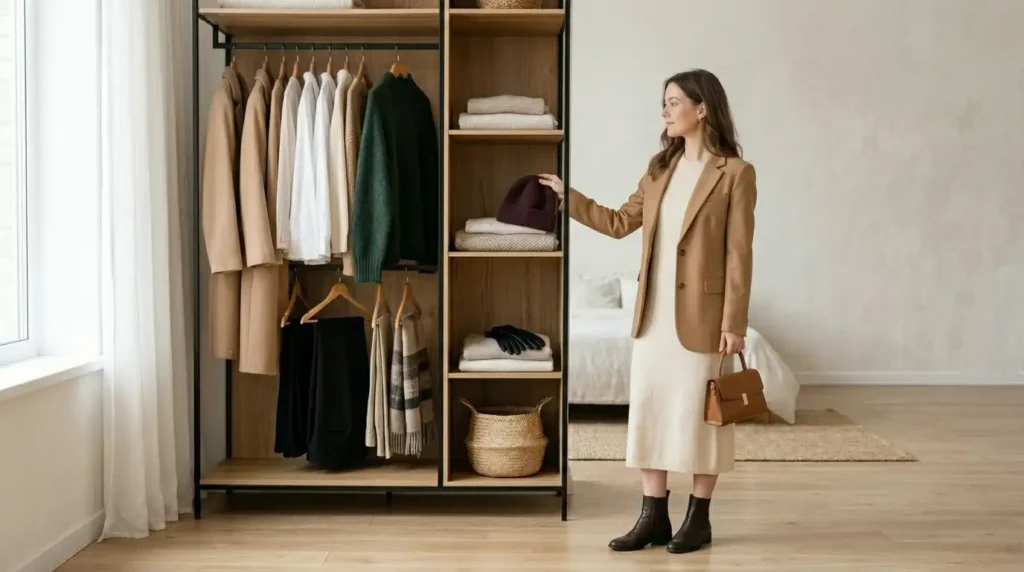
Finish the capsule with one practical bag that works with most of the wardrobe. A compact-to-medium structured shape usually feels more balanced on a petite frame than an oversized tote.
If you’re deciding which of these pieces deserve more of your budget, compare them with these petite wardrobe investments before shopping.
The real test of a capsule wardrobe isn’t how good the pieces look individually. It’s how easily they move from one season to another.
With the right layers and proportions, the same 15 pieces can cover warm afternoons, cool spring mornings, crisp fall days, and much of winter.
Spring & Summer
Warm-weather dressing should feel light rather than overly complicated. Start with your T-shirt, button-down, skirt, jeans, or dress, then add structure only when you need it.
Try combinations such as:
- Fitted T-shirt + straight-leg jeans + loafers
- Button-down shirt + skirt + ballet flats
- Simple dress + structured bag + flats
- T-shirt + tailored trousers + minimal sneakers
- Button-down worn open over a T-shirt + jeans + flats
For petites, keep an eye on where layers finish. A shirt that ends around the hip can work well with high-rise bottoms, while a shorter cardigan or jacket can make the waistline easier to see.
Fall & Winter
Cold-weather dressing is where a small wardrobe needs more strategy. Instead of adding lots of bulky pieces, layer the existing ones in different ways.
Useful combinations include:
- T-shirt + cardigan + tailored trousers + ankle boots
- Button-down + fine-knit sweater + jeans + loafers
- Dress + blazer + ankle boots
- T-shirt + cardigan + short jacket + straight-leg jeans
- Sweater + tailored trousers + structured coat + boots
The key is controlling the amount of fabric around your body. A fitted base layer under one structured outer layer often looks cleaner than several oversized pieces stacked together.
For petite women, matching similar tones can also help create a continuous visual line. You don’t need to dress head-to-toe in one color; keeping your trousers and shoes in related shades can be enough.
The Seasonal Layering Rule
Think of your capsule in three levels:
- Base: T-shirt, button-down, dress, or lightweight top.
- Middle: Cardigan, sweater, or blazer.
- Outer: Jacket or coat.
You won’t always need all three.

On a mild day, the base plus a blazer may be enough. In winter, add the sweater or cardigan and finish with your coat. This keeps the wardrobe flexible without requiring a separate closet for every season.
A minimalist wardrobe works best when each layer has a clear purpose. Vogue’s guidance on minimalist dressing similarly focuses on choosing useful wardrobe foundations rather than simply accumulating more clothes.
Vogue’s guide to the minimalist wardrobe similarly emphasizes thoughtful foundations and pieces that can work across seasons. Vogue — 10 Steps to the Essential Minimalist Wardrobe.
A small wardrobe only works if the pieces fit well enough to be worn often. For petite women, shopping should focus less on the label size and more on proportions such as shoulder width, rise, sleeve length, and hem placement.
Check the Proportions First
Before buying a piece, look at where its main lines fall on your body.
- Shoulders: Blazers, coats, and shirts should sit close to your natural shoulder line. Excess fabric here can make the entire garment look oversized.
- Waist: High- or mid-rise bottoms can help create a clear waist-to-leg proportion. Check that the waistband sits where you actually want it rather than relying on the product description.
- Sleeves: Sleeves that extend too far over the hands can make even an otherwise well-fitting jacket look too large.
- Trousers: The hem should finish intentionally. If you’re constantly folding or bunching the fabric, the cut may not be right for you.
- Jacket length: A shorter structured jacket can create a different proportion from a longer coat, giving your capsule more styling options.
- Skirt length: Don’t assume every petite woman needs the same hem length. Try different points and see where your legs look most balanced.
Fabric Matters More Than You Think
Fabric weight changes how a garment sits on a smaller frame.

Look for:
- Fine knits that layer easily.
- Medium-weight tailoring that holds its shape.
- Denim with enough structure to keep a clean leg line.
- Drapey fabrics that don’t create unnecessary bulk.
- Coats that provide warmth without excessive padding or volume.
Very heavy fabrics aren’t automatically wrong. They simply need more careful proportion control.
Build Around a Cohesive Palette
A limited color palette makes 15 pieces feel like many more.
A practical starting point could include:
| Base Colors | Supporting Shades | Accent |
|---|---|---|
| Cream, white, black | Camel, beige, taupe | One personal accent |
| Dark denim | Navy, charcoal | One seasonal shade |
You don’t need to remove color from your wardrobe. The goal is simply to make the majority of your pieces easy to combine.
Think About Cost Per Wear
Price alone doesn’t tell you whether something belongs in a capsule.
A $30 top worn twice isn’t necessarily a better purchase than a $90 blazer worn dozens of times. Consider how frequently you’ll use the piece, how many outfits it creates, and whether its quality is appropriate for that amount of wear.
And don’t assume capsule dressing means expensive shopping. You can find plenty of budget-friendly petite outfits while keeping the same principles of proportion and versatility.
Fifteen pieces don’t have to mean 15 predictable outfits. The best combinations come from changing proportions, layers, and shoes while keeping the same core wardrobe.
Formula 1: Jeans + Fitted Top + Blazer
Start with the neutral T-shirt and straight-leg jeans. Add the structured blazer and loafers when you want the outfit to feel polished without becoming formal.
For a petite frame:
- Keep the T-shirt neatly tucked or slightly cropped.
- Choose a blazer that doesn’t extend far past the hips.
- Use a similar shade for your shoes and jeans when you want a longer-looking leg line.
Formula 2: Trousers + Fine-Knit Sweater + Flats
This is one of the easiest combinations for work, dinners, or everyday polished dressing.
Choose tailored trousers with a clean waist and pair them with a fine-knit sweater. Finish with loafers or ballet flats.
The outfit stays simple, but the tailored bottom gives it enough structure.
Formula 3: Skirt + Button-Down + Cardigan
A skirt doesn’t have to be reserved for warm weather. Wear it with the button-down in spring, then add the cardigan when temperatures fall.
Try:
- A partial tuck rather than leaving the shirt completely loose.
- A shorter cardigan that finishes near the waist.
- Flats for a lighter look or ankle boots for cooler weather.
This combination also gives you a useful way to vary your wardrobe without buying another bottom.
Formula 4: Dress + Blazer + Ankle Boots
A simple dress can carry much more of the wardrobe than its one-piece design suggests.
Add a blazer for structure and ankle boots for cooler months. In warmer weather, remove the blazer and switch to flats.
The result is two distinctly different outfits from the same dress.
Formula 5: Tonal Outfit + Structured Outerwear
When you want a particularly clean silhouette, build the base in closely related shades.
For example:
- Cream top
- Beige trousers
- Camel blazer
- Neutral loafers
- Structured bag
The similar tones create fewer visual breaks, while the structured outer layer adds definition.
These formulas work because each item has a clear role. Instead of asking, “What can I wear with this?” you’re building around combinations you already know will work.
If you’re trying to keep spending controlled while experimenting with these formulas, the earlier £50 challenge is a useful example of how to build a petite outfit on a budget.
Fifteen pieces can cover a lot, but they aren’t a universal limit. Your climate, job, lifestyle, and social calendar may require a few additional categories outside the core capsule.
A good minimalist wardrobe should make your life easier, not force every situation into the same 15 pieces.
Climate Makes a Difference
A year-round capsule looks different depending on where you live.

- Warm climates: You may need more breathable tops and fewer heavy layers.
- Cold climates: A winter coat, warmer knitwear, and cold-weather accessories may need to sit outside the 15-piece core.
- Four-season climates: Layering becomes more valuable because the same base pieces can work across several months.
- Rainy climates: Waterproof outerwear and suitable shoes may be practical necessities rather than optional extras.
The 15 pieces are best treated as the core wardrobe, not a strict rule that every garment you own must fit inside.
Workwear Can Change the Formula
Someone working from home may need very different clothing from someone in a formal office.
You might need additional:
- Tailored trousers
- Work-appropriate blouses
- Formal dresses
- Structured jackets
- Occasion shoes
That doesn’t mean the capsule has failed. It means your wardrobe needs to reflect how you actually spend your week.
Special-Occasion Clothing Is Different
Wedding guest outfits, formal events, athletic clothing, swimwear, sleepwear, and highly seasonal pieces don’t necessarily need to compete for space within the 15-item everyday capsule.
Keep the distinction clear:
Core capsule: pieces you repeatedly mix and wear.
Specialty wardrobe: clothing designed for a specific activity, season, or occasion.
This prevents the capsule concept from becoming unnecessarily restrictive.
Personal Style Still Matters
A minimalist wardrobe shouldn’t make everyone look identical.

If you love color, keep an accent shade. If you prefer feminine dresses, give the dress more attention. If trousers are your everyday uniform, prioritize them over a skirt.
The point is to own fewer pieces that you’ll actually reach for.
A capsule is successful when it reflects your real life—not when it hits an arbitrary number.
You don’t need to buy all 15 pieces in one shopping trip. In fact, building the wardrobe gradually usually makes more sense because you’ll learn which gaps actually affect your daily outfits.
Start with what you already own, then shop only for pieces that solve a real problem.
1. Audit Your Current Wardrobe
Pull out the clothes you wear regularly and separate them into three groups:
- Keep: Fits well, gets worn often, and works with several outfits.
- Alter: Good piece, but the hem, sleeve, or waist needs adjustment.
- Replace: Poor fit, uncomfortable fabric, or rarely worn.
Don’t remove something simply because it isn’t part of the 15-piece list. If you love it and wear it regularly, it has already proved its value.
2. Find Your Biggest Gaps
Look at your outfits from the past few weeks.
Ask yourself:
- Do I have enough everyday tops?
- Am I missing a polished bottom?
- Do my shoes work with most of my trousers and skirts?
- Can I layer my clothes when the temperature changes?
- Do I have one outfit that works when I need to look more polished?
The answers will tell you what to buy first.
3. Prioritize High-Use Pieces
Start with pieces that unlock several outfits.
A neutral pair of trousers might work with your T-shirt, button-down, cardigan, blazer, and sweater. That’s a much stronger first purchase than a statement piece that works with only one outfit.
A useful order is:
- Fill everyday wardrobe gaps.
- Add the most versatile layer.
- Add a second bottom if needed.
- Complete your practical shoe options.
- Finish with specialty or style-driven pieces.
4. Don’t Force the Number
The number 15 is a framework, not a shopping challenge.
You might already own 11 suitable pieces. Great. You only need to identify four genuine gaps.
Or perhaps your lifestyle requires 18 core pieces. That’s fine, too.
The best minimalist wardrobe is one where every item has a reason to be there. If a piece doesn’t fit your proportions, lifestyle, or personal style, buying it just to complete a checklist defeats the purpose.
Build Slowly, Then Reassess
Give new purchases time to prove themselves.
After a few weeks, notice which combinations you repeatedly reach for and which pieces stay untouched. That information is more useful than trying to predict your perfect wardrobe on day one.
A thoughtful capsule isn’t about owning the smallest possible closet. It’s about making the clothes you own work harder, fit better, and feel easier to wear.

Conclusion
A 15-item wardrobe can give a petite woman plenty of outfit options when the pieces are chosen around fit, proportion, and versatility. Start with what you already own, fill the genuine gaps, and let your wardrobe grow around the clothes you actually wear.
The goal isn’t the smallest possible closet. It’s a wardrobe that feels easy, polished, and genuinely yours.
FAQs
Can a petite woman really have a 15-item year-round wardrobe?
Yes. The 15 pieces work as a core wardrobe, with layering allowing many items to transition between seasons. Specialty clothing such as activewear, occasionwear, and extreme-weather gear can sit outside the core.
What should I buy first for a petite capsule wardrobe?
Start with the pieces you’ll wear most often. A fitted neutral top, versatile trousers or jeans, and a practical layering piece usually create more outfit combinations than a statement item.
What makes a capsule wardrobe flattering for petites?
Pay attention to proportions rather than simply choosing petite-labeled clothing. Shoulder width, rise, sleeve length, jacket length, and trouser hems can all affect how balanced an outfit looks.
Should every capsule piece be neutral?
No. A neutral foundation makes mixing easier, but an accent color can add personality. The important thing is that the majority of your pieces coordinate naturally.
Is a minimalist wardrobe always cheaper?
Not necessarily. The aim is to buy more intentionally, not automatically spend less. A well-chosen piece that gets worn frequently can be more useful than several inexpensive items that rarely leave the closet.


