The 2/3 Rule for Petite Proportions: Look Taller

Some petite outfits look instantly longer and more balanced, while others seem to cut the body into smaller sections—even when every individual piece fits well. The difference is often proportion.
That’s where the 2/3 rule comes in. In simple terms, it’s a styling principle that aims to avoid splitting an outfit into two equal halves. Instead, one section visually takes up about two-thirds of the silhouette while the other occupies roughly one-third. A tucked top with high-rise trousers is the classic example: the top creates the shorter section, while the trousers carry the longer visual line.
For petite women, this can be especially useful because small changes in waist placement, hem length, or layering can have a noticeable effect on how an outfit reads.

The trick isn’t following the ratio with a measuring tape. It’s learning to see the proportion—then adjusting your clothes until the overall silhouette feels intentional.
What Is the 2/3 Rule in Petite Fashion?
The 2/3 rule is about creating an uneven visual split in an outfit instead of cutting the body into two equal halves. For petite women, the most useful version is usually a shorter-looking top section with a longer-looking bottom section. Think tucked blouse + high-rise trousers. The waist becomes the visual break, while the legs carry more of the outfit’s length.

The basic idea
Picture your outfit as three visual sections:
- 1/3: the area from your shoulders toward your waist
- 2/3: the area from the waist toward your feet
- The dividing point can come from a waistband, tucked hem, belt, jacket edge, or strong color change.
You don’t need to measure yourself. Your eye is looking for the placement of the break.
A long top ending around the widest part of the hips can create a roughly 50/50 feeling, especially when paired with shorter or low-rise bottoms. Move that top into a tuck, shorten its visual length, or raise the waistband, and the silhouette can read very differently. The rule is widely used as a styling tool because shifting that horizontal break can make the overall line appear longer.
For petite women, this doesn’t mean every outfit needs cropped clothing. Body shape still matters. A proportion that works beautifully on one petite frame may feel awkward on another, particularly around the waist and midsection. That’s why proportion should be considered alongside fit and shape, as shown in our guide to petite apple shape styling.
Quick rule: don’t ask, “Is this top too long?” Ask, “Where does this outfit visually divide my body?”
That question is much more useful.
Why Proportion Matters More on a Petite Frame
Petite styling isn’t about making every garment smaller. It’s about controlling where the eye sees visual breaks. A long top, contrasting waistband, jacket hem, or cropped trouser can divide the silhouette in a way that makes the outfit feel shorter or more fragmented. The rule of thirds helps you decide where those breaks should land.
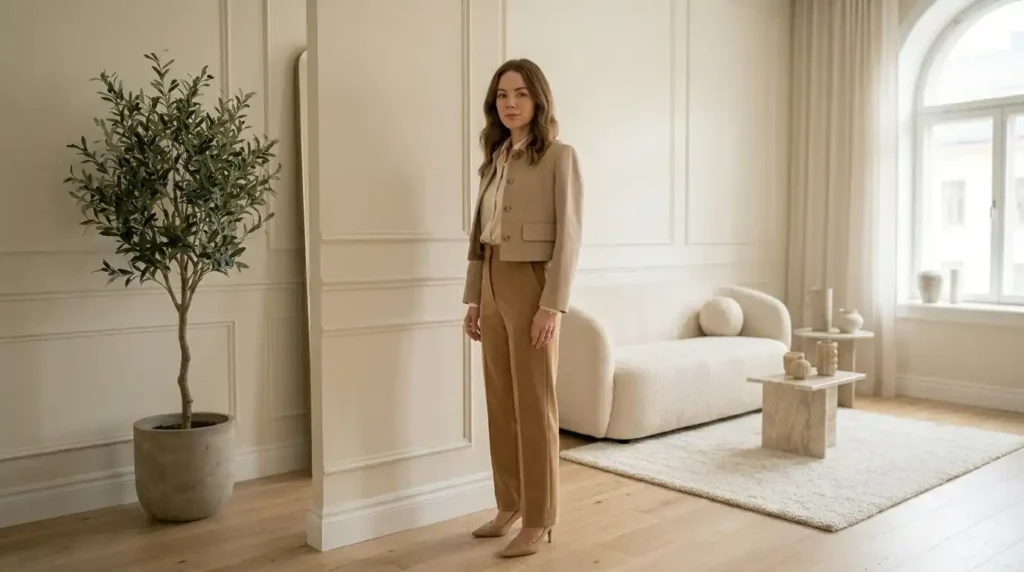
The Eye Follows Clothing Lines
Your eye naturally notices strong horizontal lines first. That means:
- A waistband can establish a clear waist point.
- A tucked top can reduce the visual length of the torso.
- A jacket ending near the waist can reinforce the same division.
- A strong color contrast can make the break even more noticeable.
The goal isn’t to remove every horizontal line. You want intentional breaks rather than several competing ones.
Length Isn’t the Same as Oversized
A longer garment doesn’t automatically make you look longer. A loose top that extends well below the waist can cover much of the leg line, while excess fabric can make a petite frame look overwhelmed.
That’s why proportion works best alongside fit. If you’re styling around a fuller midsection, for example, the ideal waist placement may differ from a standard tucked-top formula. Our guide to petite apple shape styling covers that distinction in more detail.
Fit Changes the Equation
A high-rise trouser can create a longer lower section, but only if the rise and waistband sit comfortably. The same goes for jackets, skirts, and dresses.
The best proportion is the one that looks deliberate and feels natural.
6 Ways to Apply the 2/3 Rule to Real Outfits
The easiest way to use the 2/3 rule is to treat it as a visual styling check, not a strict measurement. You’re looking for an intentional one-third/two-thirds relationship, usually by making the upper section shorter and allowing the lower section to carry more visual length.

This idea fits into a broader approach to dressing for your proportions, where garment length, fit, and tailoring work together to create a balanced silhouette.
1. Start With a Higher Visual Waist
A higher waistline gives the eye an earlier starting point for the longer lower section. You can create that effect without buying anything new.
- Tuck a blouse into high-rise trousers.
- Try a neat French tuck with relaxed jeans.
- Use a belt to clearly mark the waist.
- Choose a cropped knit that finishes around the waistband.
- With dresses, a defined waist can create a similar visual break.
The key is where the eye sees the division. If your top hangs far below the waistband, much of that length disappears into the upper section.
2. Let High-Rise Bottoms Do the Heavy Lifting
High-rise trousers, jeans, and skirts can place the waistband higher on the body, giving the lower section more visual territory.
For a petite frame, try:
- Full-length straight-leg trousers with a tucked top.
- High-rise jeans with a fitted knit.
- A high-waisted skirt with a shorter cardigan.
- Matching or closely related colors from waist to hem.
You don’t need an extremely high rise. Comfort still wins.
3. Choose Jacket Length With Intention
A jacket can either reinforce your proportions or interrupt them.
A waist-length or cropped jacket works naturally with high-rise bottoms because the two pieces meet around the same visual point. A longer jacket can work too, but its hem becomes another major horizontal line.
Before choosing the shortest option, check the whole outfit. The jacket should support the silhouette, not simply be short.
4. Build Longer Lines With One Color Family
Color can strengthen the proportion you’ve already created. When your trousers and shoes sit in a similar tonal family, the transition between them becomes less visually abrupt.
Try:
- Cream trousers + beige shoes.
- Dark trousers + dark footwear.
- Taupe skirt + nude-toned shoes.
- A monochromatic outfit with one contrasting accessory.
You’re not trying to dress head-to-toe in one shade. The goal is simply to avoid unnecessary visual interruptions through the longest section of the outfit.
5. Watch Where Your Hemlines Break
A hem can change the entire reading of an outfit.
Check the exact point where these pieces finish:
- Tops
- Cardigans
- Jackets
- Skirts
- Dresses
- Trousers
A top ending around the widest part of the hips can create a strong horizontal break. Move that hem slightly higher, tuck it, or create a cleaner transition, and the proportions can look noticeably different.
The same principle applies below the waist. Full-length trousers can create a continuous line, while an awkwardly cropped hem may interrupt it.
6. Use Shoes to Finish the Line
Shoes are the final piece of the lower section, so don’t treat them as an afterthought.
A few simple choices can keep the visual line moving:
- Match shoes closely to trousers when possible.
- Try pointed or almond-toe shapes for a longer visual finish.
- Avoid unnecessary contrast at the ankle when you’re trying to create one continuous line.
- Let full-length trousers fall cleanly over the shoe rather than bunching heavily.
The 2/3 rule isn’t about making your feet disappear. It’s about finishing the longer section cleanly so the outfit doesn’t suddenly stop at the ankle.
2/3 Rule Outfit Formulas for Petite Women
The 2/3 rule becomes much easier when you stop thinking about ratios and start thinking in outfit formulas. A tucked top with high-rise trousers is the familiar example, but you can create the same visual imbalance in several different ways.

High-Rise Jeans + Tucked Top + Short Layer
This is one of the easiest casual combinations to build.
- High-rise straight-leg jeans
- Fitted or lightly relaxed top
- Tucked or French-tucked hem
- Waist-length cardigan or jacket
- Shoes that don’t create a harsh break at the ankle
The waistband establishes the visual starting point for the longer lower section. The short outer layer reinforces it.
Midi Skirt + Fitted Top
A midi skirt doesn’t automatically make a petite frame look shorter. The styling around it matters more.
Try:
- A high-waisted midi skirt
- A fitted knit or tucked blouse
- A defined waist
- Shoes that complement the skirt rather than creating a strong ankle contrast
The shorter upper section keeps the longer skirt from taking over the entire silhouette.
Tailored Trousers + Waist-Length Knit
For workwear or polished everyday dressing, this formula is particularly clean.
- High-rise tailored trousers
- Waist-length knit or tucked blouse
- Slim belt if useful
- Minimal footwear
- One structured accessory
The trousers become the dominant visual section. A neatly finished top prevents the torso from visually swallowing too much of the outfit.
One-Color Column + Defined Waist
You don’t always need an obvious color contrast to create proportion.
A tonal outfit can keep the eye moving vertically, while a belt or tucked hem establishes the waist. The result is a defined break without chopping the silhouette into disconnected blocks.
This approach is especially useful when you prefer minimalist outfits.
Short Dress + Elongating Shoes
The 2/3 rule can also work in the opposite direction. A short dress can create a larger visual area above the hem, leaving the lower third for the legs and shoes. The rule isn’t limited to making the bottom two-thirds longer.
Choose a dress with a deliberate hemline rather than one that lands awkwardly at mid-thigh or knee. Then keep the footwear visually clean.
The goal isn’t to follow one formula every day. It’s to recognize when an outfit is creating a clear visual hierarchy—and when a small change could make the proportions feel more intentional.
When the 2/3 Rule Doesn’t Work
The 2/3 rule is useful, but it isn’t a law. Proportion should help you understand an outfit—not force every petite woman into cropped tops and high-rise trousers. Even petite-style guidance notes that the rule can be reversed, with a longer upper section and shorter lower section, depending on the silhouette.

Sometimes breaking the rule creates the better outfit.
- Oversized layers: A relaxed coat or oversized blazer can work when the rest of the outfit provides enough structure. The trick is controlling volume rather than shortening every layer.
- Longline silhouettes: A streamlined long coat or column-shaped dress can create one continuous vertical impression instead of relying on a visible 1/3–2/3 split.
- Low-rise bottoms: They don’t automatically ruin an outfit. They simply place the visual break lower, so the rest of the silhouette needs to support that choice.
- Relaxed dresses: A dress doesn’t need a sharply defined waist to look balanced. A clean, uninterrupted shape can sometimes feel more elegant.
- Statement proportions: Fashion is allowed to be interesting. An intentionally oversized shirt, dramatic jacket, or unusual hem can work precisely because it breaks the expected formula.
- Personal body proportions: A petite woman with a short torso may not want to push the waistline dramatically higher. Someone with longer legs may prefer a different balance.
The better question isn’t, “Am I following the 2/3 rule?”
Ask: “Does this outfit have a clear visual balance?”
If the answer is yes, you don’t need to fix something simply because the numbers aren’t perfect.
How to Check Your Outfit in 10 Seconds
You don’t need to calculate your proportions every time you get dressed. A quick full-length check is enough to spot the biggest visual breaks. The rule of thirds works best as a fast styling test, especially when you’re deciding whether a hem, waistband, or layer is helping the silhouette.
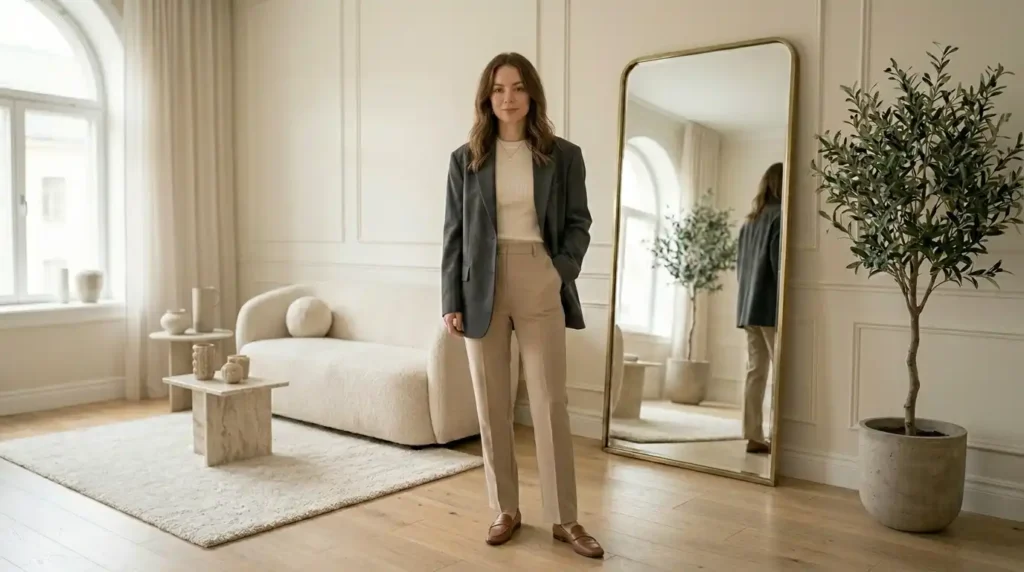
Find the Main Horizontal Break
Look straight at the outfit and identify the strongest line:
- Waistband
- Belt
- Tucked shirt hem
- Jacket hem
- Skirt or dress hem
- Strong color change
Ask where that line sits on your body. If it lands around the middle and divides the outfit into two similar-looking halves, try moving one element.
Ask Which Section Looks Larger
Now step back.
Does the outfit visually give you one larger section and one smaller section? A tucked top with high-rise trousers, for example, creates a noticeably shorter upper section and longer lower section. That’s the visual relationship you’re looking for.
Remove One Competing Break
If the outfit feels chopped up, don’t change everything.
Try removing just one interruption:
- Untuck a top if the waistband creates too many competing lines.
- Remove a contrasting belt.
- Choose shoes closer in color to the trousers.
- Swap a long cardigan for a shorter layer.
- Let trousers fall cleanly instead of stopping at an awkward point.
Small edits can change the whole reading of an outfit.
Take a Full-Length Photo
A mirror can make proportion harder to judge because you’re standing close and looking down at yourself. Take one quick full-body photo from a little farther away.
Then check the silhouette as a whole.
If you want to turn these proportion ideas into repeatable outfits instead of rebuilding your wardrobe from scratch, the Petite Capsule Outfit Formula is a useful next step.
The goal isn’t mathematical perfection. It’s simply learning to spot when your clothes are creating a clean, intentional visual balance.
Quick Comparison: Petite Proportion Choices
The 2/3 rule isn’t about making every outfit look identical. Different garments create different visual divisions, so the better question is which pieces help your silhouette feel intentional. The rule of thirds is commonly used in petite styling to avoid a visually equal split and create a more deliberate relationship between the upper and lower sections.

| Styling choice | Usually helps create | Watch out for |
|---|---|---|
| High-rise bottoms | A longer-looking lower section | A rise that’s uncomfortable or excessively high |
| Tucked or cropped top | A higher visual waist | Excess fabric bunching at the waist |
| Tonal outfit | A smoother vertical flow | Losing useful waist definition |
| Waist-length jacket | A clearer body division | A boxy, stiff silhouette |
| Long, clean trouser line | More continuous leg length | Heavy bunching around the ankle |
| Contrasting hemline | A deliberate visual break | A break landing at an awkward point |
For petite dressing, the strongest combinations usually come from coordinating several small proportion choices, rather than relying on one garment to do all the work.
The table is a starting point. Your own torso-to-leg ratio, preferred fit, and body shape still determine which version feels best.

Conclusion
The 2/3 rule is best used as a visual styling tool, not a strict formula. For petite women, shifting a waistband, shortening a top, cleaning up a hem, or reducing one competing break can make an outfit feel noticeably more balanced.
Start with one change. Once you can see how the proportions shift, getting dressed becomes much easier.
FAQs
Does the 2/3 rule work for every petite body shape?
Not in exactly the same way. The principle can be useful across different body shapes, but waist placement, garment fit, and comfort still matter. A proportion that works for a short-torso petite woman may not be the best choice for someone with a longer torso.
Do petite women always need high-waisted bottoms?
No. High-rise bottoms are one way to create a higher visual waist, but they’re not mandatory. A tucked top, cropped jacket, defined belt, or well-placed dress waist can create a similar visual division.
Can petite women wear long coats and maxi dresses?
Absolutely. Length alone isn’t the problem. A long garment can create a strong uninterrupted line when its shape is clean and properly fitted. The 2/3 rule is a guide for visual balance, not a ban on longer clothing.
Is the 2/3 rule the same as trying to look taller?
They’re related, but not identical. The 2/3 rule focuses on proportion, while looking taller can also involve color continuity, footwear, garment fit, and vertical lines. The proportion principle is one tool within a larger styling approach.
What is the easiest way to try the rule today?
Start with something already in your wardrobe. Tuck a top into high-rise trousers or jeans, add a shorter outer layer, and compare the silhouette with the same outfit worn untucked. A full-length photo can make the difference easier to see.


